Web Development in 2026: The Era of Intent Over Implementation
From AI-first workflows and server-first rendering to TypeScript and edge computing — here's what is shaping how the web is built in 2026.

On This Page
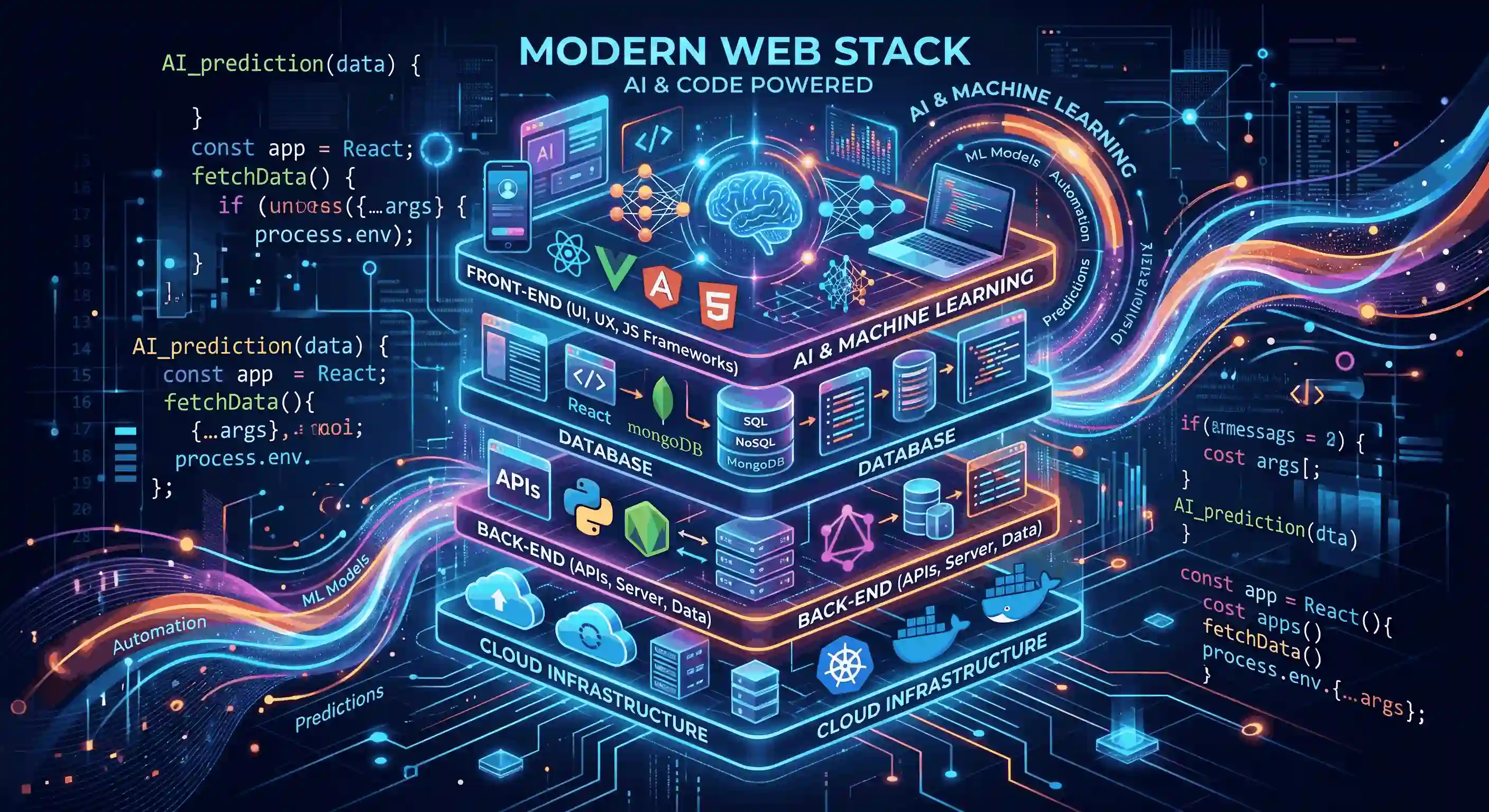
There’s a particular feeling developers get when the ecosystem quietly shifts under their feet. Not the dramatic “everything changed overnight” kind — but the slow-burn realisation that the tools you reached for last year now feel slightly foreign. That feeling? Welcome to web development in 2026.
The loading spinners are gone. The massive client-side JavaScript bundles are shrinking. The “should we use TypeScript?” debate has been settled. And the AI that once autocompleted single lines of code is now scaffolding entire full-stack applications from a prompt.
This isn’t a list of hype. Every trend here is already running in production, already changing how teams hire, already baked into the frameworks you’re probably using today. Let’s walk through all of it.
🖥️ Server-First is the New Default
Remember when we shipped 400 KB of JavaScript just to render a navigation bar? Those days are fading fast.
In 2026, the pendulum has swung decisively back to the server. With React Server Components (RSC) now a stable, widely-adopted pattern and SSR baked into virtually every major meta-framework, the philosophy has reversed: the server renders everything it can, and the client only receives the JavaScript it actually needs.
This isn’t nostalgia for PHP. It’s a fundamentally smarter split. Static markup travels light. Interactivity ships only where required. The result is applications that feel instant — not because of clever loading tricks, but because the architecture earned it.
What this means for you
You now have to make an architectural decision up front: what is static, and what needs the client? That discipline is the new literacy. Components default to server-rendered. "use client" is an opt-in, not an assumption.
Here’s the mental model shift in practice:
// ❌ 2022 thinking — client does everything
"use client";
export default function BlogList() {
  const [posts, setPosts] = useState([]);
  useEffect(() => {
    fetch("/api/posts").then(r => r.json()).then(setPosts);
  }, []);
  return <ul>{posts.map(p => <li key={p.id}>{p.title}</li>)}</ul>;
}

// ✅ 2026 thinking — server does the heavy lifting
// No "use client" directive needed — this runs on the server
export default async function BlogList() {
  const posts = await db.posts.findMany({ orderBy: { date: "desc" } });
  return <ul>{posts.map(p => <li key={p.id}>{p.title}</li>)}</ul>;
}
Less JavaScript shipped. Zero loading state. Zero fetch waterfall. That’s the trade, and it’s a spectacular one.
🤖 AI is a Coworker, Not a Toy
Let’s get one thing straight: AI coding tools graduated from “party trick” to core infrastructure somewhere in 2025, and 2026 is the year teams stopped debating whether to use them and started debating how to govern them.
Tools like GitHub Copilot, Cursor, and Codeium no longer just suggest lines — they suggest entire functions with project-context awareness, flag edge cases before you hit them, and scaffold full-stack flows from design files or plain English prompts.
"A single experienced developer using the right AI-driven framework will run a team of agents with the same efficiency and output as a team of 4–5 engineers."
But here’s the nuance the hype cycle misses: the best developers in 2026 aren’t the ones who prompt the most. They’re the ones who design the best guardrails. AI writes the boilerplate. You write the architecture. You define the constraints. You own the review.
The real trap to avoid
“Everyone is building a prompt box,” and that pattern is already running out of steam. The teams winning with AI are the ones building beautiful interfaces that abstract the AI away — interactions that feel intuitive, not robotic. A chat window is not a product.
Practical rule of thumb for teams in 2026:
## AI-Assisted Code Policy (example)
- ✅ Use AI to generate tests and documentation *after* architecture is finalised
- ✅ Use AI for boilerplate, repetitive transformations, and first-draft components
- ⚠️  Always run license + security scan on AI-generated code before merging
- ❌ Don't let AI decide your system design — that's yours
- ❌ Don't ship generated code without a human review + type-check pass
🏗️ Meta-Frameworks Ate the Stack
Here’s a thing that barely needs saying in 2026: the era of manually configuring routers, bundlers, and build pipelines is over.
Meta-frameworks like Next.js, Nuxt, and Remix have completed their evolution from “helpful starter kits” to “the entire stack.” Routing, data fetching, caching, rendering strategy, API layers — it’s all one coherent system. With Server Actions now mainstream, the backend for many projects is literally just a folder inside the frontend repo.
my-app/
├── app/
│   ├── page.tsx          ← Server Component (zero JS to client)
│   ├── layout.tsx
│   ├── blog/
│   │   └── [slug]/
│   │       └── page.tsx  ← Dynamic route, still server-first
│   └── api/
│       └── webhook/
│           └── route.ts  ← API route, lives right here
├── actions/
│   └── posts.ts          ← Server Actions — your "backend", just functions
└── components/
    └── LikeButton.tsx    ← "use client" only where interactivity is needed
The generative AI builders accelerated this. When Vercel’s v0, Bolt, and Lovable scaffold a new project, they produce meta-framework projects by default. The choice has been made for you — and honestly, it’s the right one.
🔷 TypeScript is the Baseline — Full Stop
The debate is over. Plain JavaScript in a professional context in 2026 is increasingly treated as a legacy choice, not a preference. TypeScript is the default.
Why the permanence? Because the web stack got deeper. Server functions, edge runtimes, and managed data layers mean your types now need to travel from the database all the way to the UI — and TypeScript is the thread that holds that journey together without duplicating contracts.
End-to-end type safety in practice
Tools like tRPC, Prisma, and the new breed of typed ORM clients make it possible to define your schema once and have TypeScript enforce correctness at every layer — DB → server function → API → component. Catch the bug before you hit the browser.
// One type, all the way through
import { type inferRouterOutputs } from "@trpc/server";
import { type AppRouter } from "@/server/routers/_app";

type RouterOutput = inferRouterOutputs<AppRouter>;
// posts.list → inferred automatically from your Prisma schema
type Post = RouterOutput["posts"]["list"][number];

// Now your component is fully typed with zero duplication
function PostCard({ post }: { post: Post }) {
  return <h2>{post.title}</h2>; // TypeScript knows every field
}
The 2026 shift is treating type safety not as a developer comfort, but as a system design tool — one that reduces regressions, speeds up onboarding, and makes large refactors survivable.
⚡ Edge Computing Is In Production
Edge computing stopped being a buzzword and started being a line item in infrastructure budgets. In 2026, deploying functions at the edge — to data centers geographically near your users — is a routine decision for teams optimising for latency.
The use cases have crystallised clearly:
| Use Case | Why Edge Wins |
|---|---|
| Personalised content delivery | Serve region-specific variants without round-tripping a central server |
| Authentication / middleware | Verify tokens at the edge before the request reaches origin |
| A/B testing | Route to variants in milliseconds, not seconds |
| Image optimisation | Resize and compress at the CDN layer |
| Rate limiting | Block abuse before it hits your database |
Platforms like Cloudflare Workers, Vercel Edge Functions, and Deno Deploy have made edge deployment feel as casual as pushing to main. The architectural implication? Your application now has three natural execution environments: the build step, the server, and the edge — and knowing which logic belongs where is a real skill.
🔒 Security Got Serious (Finally)
2025 was a wake-up call. High-profile vulnerabilities hit widely-used tools — including the Next.js middleware vulnerability and CVE-2025-55182 — and the industry collectively remembered that React applications now handle authentication, data access, and business logic that once lived exclusively on locked-down backend servers.
The expanded attack surface is real. A misconfigured middleware, a leaky cache, a Server Action that skips an auth check — these have real consequences now.
The supply chain risk is real
npm supply-chain attacks increased by 150% between 2024 and 2026. A single compromised package can expose an entire project. In 2026, npm audit in CI is not optional — it’s table stakes.
The response from the framework ecosystem has been decisive: defensive defaults. Safer APIs, stricter middleware behaviour, tighter integration with static analysis, clearer warnings during development. The goal is making insecure patterns hard to reach accidentally, not just documented as bad practice.
Your 2026 security checklist:
# Lock your dependencies
npm ci                    # uses package-lock.json exactly

# Audit every install
npm audit --audit-level=high

# Scan behaviourally (beyond known CVEs)
npx socket scan           # Socket.dev behavioural analysis

# Enforce headers at the edge
# In next.config.ts:
headers: [
  { key: "X-Frame-Options", value: "DENY" },
  { key: "Permissions-Policy", value: "camera=(), microphone=()" },
  { key: "Referrer-Policy", value: "strict-origin-when-cross-origin" },
]
🎨 CSS Grew Up (And Tailwind Grew With It)
Here’s a 2026 truth that ruffled some feathers: native CSS is quietly extraordinary now. Container queries, @layer, cascade layers, :has(), color-mix(), light-dark(), logical properties — the platform evolved, and so did how we use it.
Tailwind v4 embraced this rather than fighting it. The new engine compiles to native CSS custom properties, drops the config file for a CSS-first approach, and generates dramatically smaller outputs. The result is a utilities workflow that enhances the platform rather than abstracting it away.
/* Native CSS in 2026 — no framework needed for this */
.card {
  container-type: inline-size;
  background: light-dark(#fff, #1a1a2e);
  color: light-dark(#111, #eee);
}

@container (min-width: 400px) {
  .card__content {
    display: grid;
    grid-template-columns: 1fr 2fr;
  }
}

/* And yes, :has() is now just... CSS */
.form:has(input:invalid) .submit-btn {
  opacity: 0.5;
  pointer-events: none;
}
The takeaway
You no longer need a heavy CSS-in-JS runtime or a 30 KB polyfill for things that browsers handle natively. Learn the platform. Use utilities where they speed you up. Don’t use them where they obscure intent.
🧩 WebAssembly Found Its Lane
WebAssembly is not going to replace JavaScript. That debate ended. What it is doing, in 2026, is running in production for a very specific, very real category of work: performance-critical applications where JavaScript simply can’t deliver the required speed.
Video editing tools. CAD applications in the browser. Music production software. Complex scientific visualisations. AI model inference running client-side. These are use cases where code written in Rust, C++, or Go compiles to Wasm and runs at near-native speed inside the browser tab.
The practical decision tree is simple: if JavaScript is fast enough, use JavaScript. If you’re hitting a performance wall on computationally intensive work, WebAssembly is a real option — not an experiment.
📱 PWAs Closed the Gap
Progressive Web Apps had years of “almost there” energy. In 2026, the “almost” is gone. Modern PWAs are production-grade replacements for native mobile apps in the majority of use cases, at a fraction of the development cost.
What changed? Browser support matured across the board. Service workers are stable. The Web App Manifest is universally honoured. Push notifications work consistently. Biometric authentication (WebAuthn) works on mobile PWAs. Background sync works. Installation prompts are reliable.
The business calculus for many teams has shifted: why maintain a React Native codebase, an iOS codebase, and a web codebase, when one well-built PWA serves all three — often indistinguishably?
// manifest.json — the heartbeat of a PWA
{
  "name": "My 2026 App",
  "short_name": "App",
  "display": "standalone",
  "start_url": "/",
  "theme_color": "#0f172a",
  "background_color": "#0f172a",
  "icons": [
    { "src": "/icon-192.png", "sizes": "192x192", "type": "image/png", "purpose": "maskable" },
    { "src": "/icon-512.png", "sizes": "512x512", "type": "image/png" }
  ],
  "share_target": {
    "action": "/share",
    "method": "POST",
    "enctype": "multipart/form-data",
    "params": { "files": [{ "name": "file", "accept": ["image/*"] }] }
  }
}
🚀 Performance is Architecture
The last shift, and perhaps the most important mindset change of 2026: performance is no longer a pre-launch checklist item. It’s a first-class architectural concern — decided at design time, enforced in CI, owned by the whole team.
Core Web Vitals still matter for SEO and UX, but the best teams in 2026 go further: they set route-level performance budgets, they enforce regressions in CI before they merge, they track real user metrics with tools like Vercel Analytics or SpeedCurve, and they treat a performance regression like a production bug — because it is one.
# .github/workflows/perf-budget.yml (simplified)
- name: Lighthouse CI
  run: |
    lhci autorun \
      --assert.preset=lighthouse:recommended \
      --assert.assertions.performance=["error", { "minScore": 0.9 }] \
      --assert.assertions.first-contentful-paint=["warn", { "maxNumericValue": 1500 }]
The principle is clean: build speed into the architecture, then protect it with automation. Don’t optimise late. Don’t treat Lighthouse as a vanity metric. Ship fast, stay fast, measure always.
🗺️ Where Does This Leave Us?
Step back and look at all ten trends together, and a single theme emerges clearly: web development in 2026 is about coordination over implementation.
Developers write less boilerplate and more intent. AI handles the mechanical. The React Compiler handles the re-renders. Meta-frameworks handle the infrastructure. TypeScript handles the contracts. Edge handles the latency. Security defaults handle the common footguns.
What’s left for you? Architecture. UX. Judgement. Taste.
That’s not a diminishment — it’s an elevation. The web has finally become the powerful, responsive, secure, fast platform we’ve been building toward for two decades. The bar for what “good” looks like is higher than it’s ever been. And the tools available to reach that bar are better than they’ve ever been.
The best time to build for the web
There has never been a better time to be a web developer. Not despite the complexity of 2026 — but because the best parts of that complexity have been absorbed into the platform, the frameworks, and the toolchain. Your job is to do the work that only a thoughtful human can do.
What trend are you most excited (or nervous) about in 2026? Drop it in the comments — I’d love to hear what’s shifting in your stack.
Keep Reading on TraceRoute X
- 🤖 Google Antigravity: The Agentic IDE That Changes How We Build Software — The AI coding tool that embodies Trend #2 in action. See what agentic development looks like in practice.
- ⚡ Stop Busy-Working: The Developer Productivity Playbook for 2026 — With all these new tools, the real challenge is protecting your focus. Here’s the playbook.
- 🎧 Apple AirPods Max 2 Review — The tech you use while you code matters too. Our honest review of Apple’s latest headphones.